Why Problem-Solving Matters More Than Ever
Children face new challenges every day, from changing school expectations to fast new technologies and social pressures. To cope with all of this, they need far more than good test scores. They need to know how to think for themselves, handle setbacks, and work things out calmly when life feels tricky. That is where strong problem-solving skills come in.
Problem-solving helps children become more resilient, more independent and more confident. School holidays are a powerful time for this, because the usual routine is paused and there is space to try new things. Adventure holiday camps give children a safe chance to practise these skills in real life, away from screens and packed timetables. Autumn breaks like October half term, and the quieter winter holidays, are often when families notice how much their children can grow in just a few days.
Real-World Challenges in a Safe Holiday Setting
At adventure holiday camps, fun activities double up as problem-solving training. The challenges feel exciting, but there is careful planning behind the scenes so children can stretch themselves without being unsafe. For example, a day at camp might include:
- An obstacle course that needs planning, balance and courage
- A scavenger hunt where teams decode clues and find hidden items
- A simple shelter-building challenge using limited kit
In each of these, children learn to break a big task into smaller steps. They work out what to try first, then what to change if that attempt does not work. Sometimes there is a time limit, which teaches them to make sensible decisions without getting stuck. When the weather in places like Leeds, York, Yarm or Cambridge turns cooler and muddier, even staying warm and dry outdoors becomes a mini problem to solve.
Experienced, Ofsted-registered staff play a key part here. Instead of jumping in with the answer, they might ask questions like, “What do you notice?” or “What else could you try?” This gentle coaching helps children think it through themselves. Over time, they learn that they do not always need an adult to fix things straight away, which is a big step toward independence.
Teamwork, Communication and Creative Thinking
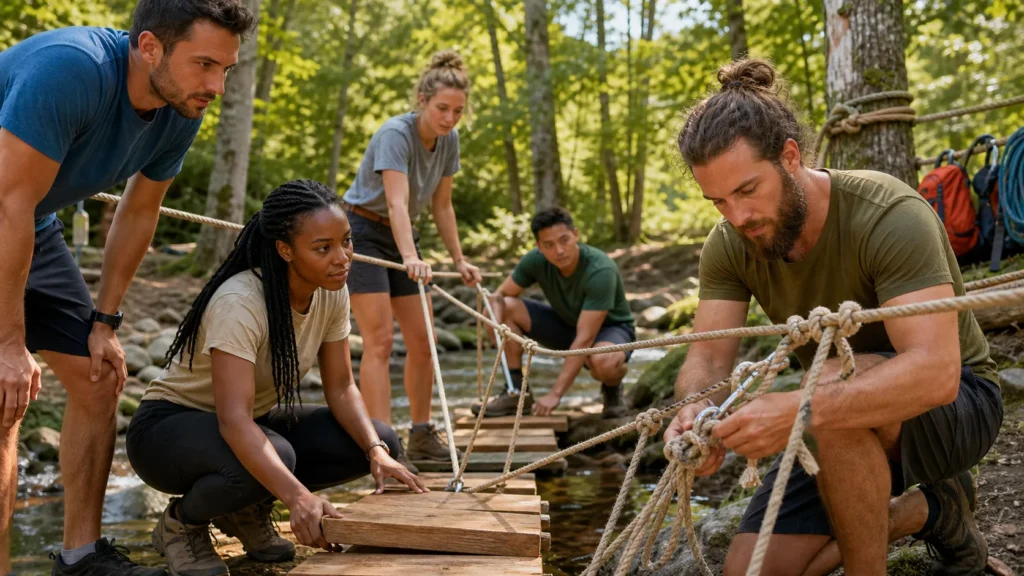
Most real-life problems are solved with other people, not alone. Adventure holiday camps are perfect places for children to practise working as a team. Group games, team sports and problem-solving missions help them learn how to:
- Listen to others without interrupting
- Share their own ideas with confidence
- Agree on roles and plans together
- Change their minds when a better idea appears
When children play a team challenge, someone needs to read the instructions, someone needs to keep track of clues, someone might keep an eye on the time. They quickly realise that speaking clearly, asking for help and giving kind feedback all make the group stronger.
Mixed-age groups add another layer of learning. Older children often take the lead in organising, explaining rules or cheering younger ones on. That builds leadership and patience. Younger children learn to speak up for themselves and to respect older voices, without feeling pushed aside. Across our locations, this mix helps build empathy, because children see that people of different ages think and communicate in different ways.
Building Confidence Through Trial, Error and Discovery
Problem-solving is not about getting everything right the first time. It is about what happens when things go wrong. At adventure holiday camps, mistakes are normal and expected. A child might:
- Slip on the climbing wall and need to try a different route
- Miss a ball in a catching game and adjust their position
- Misread a clue and have to rethink with the team
Because these moments happen in a friendly, supervised setting, children quickly learn that a “failure” is just information. They can laugh, reset and try again. Every small success that follows, from solving a puzzle to finally reaching the top of a challenge, starts to build a strong “I can do this” feeling.
Inclusive childcare is key to this. Activities are adapted so every child, from the most cautious to the boldest, can join in. Some might get a simpler version of a task or extra guidance, while others are stretched with extra steps. The aim is that each child experiences progress at their own level and goes home feeling proud of what they managed, not worried about what they could not do yet.
Everyday Life Skills Hidden in Holiday Camp Fun
Many of the big life lessons at camp hide inside very ordinary tasks. Children are not just learning how to climb or build, they are also learning how to organise themselves and think ahead. For example, they might:
- Pack and care for their own kit
- Keep track of time between activities
- Read simple instructions and follow safety guidance
- Make small choices about what to try next
Younger children can be given responsibilities like choosing equipment for a game, pouring their own drink or helping to tidy up shared spaces. Older children might help plan a mini event for their group, set up part of an activity or lead a warm-up game. All of this builds the habit of noticing what needs doing and working out a sensible way to do it.
These skills carry straight into home and school life. A child who has practised sorting their bag at camp may find it easier to organise homework. A child who has worked through tricky team challenges can be calmer when there is a friendship wobble or a change in routine around busy times of year. Problem-solving stops being something “hard” and becomes just part of normal life.
How Parents Can Nurture Problem-Solving After Camp
The good news is that parents can keep these skills growing long after the holiday ends. You do not need special equipment, just a bit of time and curiosity. Some simple ideas include:
- Nature walks with mini challenges, like finding certain colours or shapes
- Cooking together, where children read the steps and measure ingredients
- Board games or puzzles that involve planning and strategy
- Simple building projects with household items
The way you talk to your child makes a big difference. Instead of stepping in with the answer, try questions such as: “What could you try next?”, “What do you think will happen if we do it this way?” or “Is there another way to solve this?” This mirrors the coaching style children experience at adventure holiday camps.
It also helps to praise the effort, not just the result. You might say, “I like how you kept trying different ideas” or “You listened to your brother’s idea and that worked well.” Giving children small, everyday choices, like which snack to pack or which jumper to wear, builds their decision-making muscles bit by bit. Over time, they start to trust their own thinking, which is exactly what problem-solving is all about.
Give Your Child An Adventure They Will Never Forget
Secure a place on our adventure holiday camps and help your child build confidence, independence and lifelong memories. At Adventure Camps we carefully design every programme to balance outdoor thrills with safety, support and fun. If you have any questions about dates, locations or suitability, just contact us and we will guide you through the next steps.