
Table of Contents
Partnerships don’t happen by accident; they are built through small, consistent actions.
- First Impressions Count
- Warm smiles, eye contact, and using children’s names at drop-off and pick-up go a long way.
- Parents want to feel that staff know their child, not that they are just another number in the register.
- Example: Instead of “Bye now!” say: “See you tomorrow, Sam — he smashed it at dodgeball today!”
- Communicate Early and Often
- Share small wins at pick-up time — “Ella really shone in drama today” or “Charlie showed great teamwork in football.”
- Don’t wait for parents to ask. Offering information proactively builds trust and prevents complaints later.
- Consistency Across Staff
- All staff should give the same message. Mixed or contradictory information from different leaders causes confusion.
- Always check with your Site Manager if you’re unsure of a detail before speaking with a parent.
- Respect and Professionalism
- Treat all parents and guardians with patience, even if they are stressed, rushed, or short with you.
- Never gossip, joke, or share frustrations about a child or family in front of others.
Effective Communication Skills #
- Listen First → Parents often just want to be heard. Resist the urge to jump in with a solution before they finish explaining.
- Acknowledge and Empathise → “I understand that must have been frustrating for you” shows that you value their perspective.
- Be Clear and Honest → Don’t overpromise. If you don’t know the answer, say, “I’ll double-check with the Site Manager and come straight back to you.”
- Body Language Matters → Keep arms open, maintain eye contact, and avoid looking rushed when speaking to parents.
Handling Complaints Professionally #
Complaints are part of camp life — no matter how good we are, things sometimes go wrong. What matters most is howwe handle them.
Step 1: Stay Calm and Professional #
- Even if a parent is upset, your role is to remain polite and non-defensive.
- Example: If a parent raises their voice, don’t match their tone. Lowering your own voice helps de-escalate the situation.
Step 2: Listen and Take Notes #
- Allow the parent to fully explain their concern without interruption.
- Use active listening: nod, repeat back key points (“So you’re concerned about the way the group was supervised in the pool — is that right?”).
- Make brief notes if needed to ensure accuracy.
Step 3: Acknowledge the Concern #
- Acknowledge the issue, even if you believe it is minor or unfounded.
- Example: “Thank you for letting me know. I can see why you’d want us to look into this carefully.”
Step 4: Refer to the Right Person #
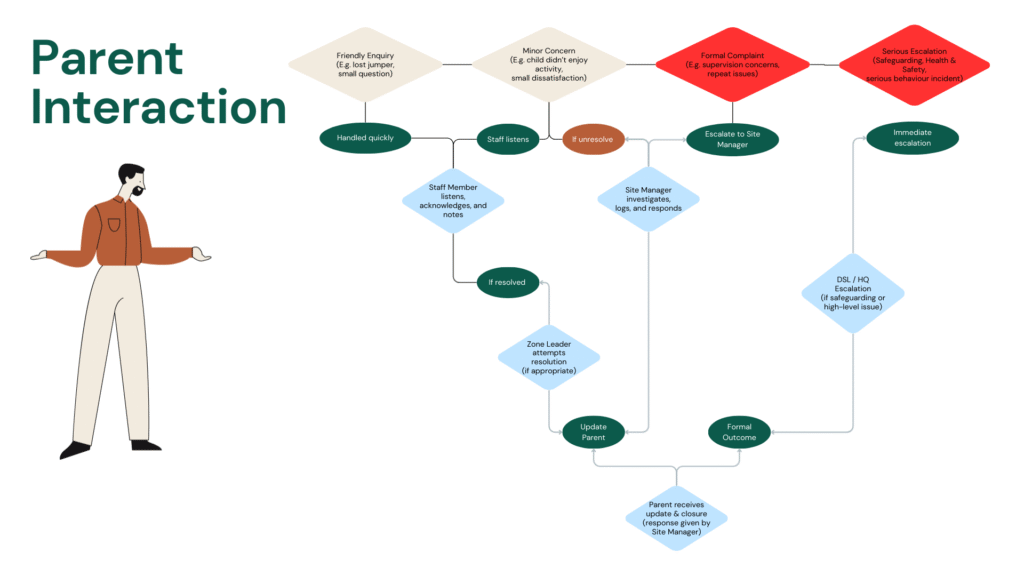
- Minor complaints (e.g., missing jumper, child didn’t enjoy one activity) can often be addressed by the Zone Leader or staff member involved.
- Any safeguarding, health & safety, or recurring behaviour complaints must be escalated immediately to the Site Manager.
- Never dismiss a concern or make promises outside your authority.
Step 5: Follow Through #
- The Site Manager (or DSL, if safeguarding is involved) will investigate, record, and respond according to policy.
- Staff may be asked for their account of events — provide it factually and without emotion.
- Ensure the parent receives timely updates. Delays in communication escalate minor issues into bigger complaints.
Examples of Good Practice #
Scenario 1: Parent upset that child’s water bottle went missing
- Wrong way: “It’s not our fault, kids lose things all the time.”
- Right way: “I’m sorry to hear that, let me help check the lost property. We’ll also remind the group tomorrow to double-check their belongings.”
Scenario 2: Parent complains child didn’t get enough turns in a game
- Wrong way: “We can’t give everyone a turn, it’s too busy.”
- Right way: “Thank you for telling me. I’ll make sure the group leader knows so we can balance things better tomorrow.”
Scenario 3: Parent shares safeguarding concern about another child’s behaviour
- Wrong way: “Yes, that child has been a problem all week.”
- Right way: “Thank you for raising this. I’ll pass it straight on to our Site Manager who will look into it immediately.”
Escalation Process for Complaints #
- Staff Member Receives Complaint → Stay calm, listen, acknowledge.
- Refer to Zone Leader or Site Manager → Do not attempt to resolve safeguarding or serious complaints on your own.
- Record → Site Manager logs complaint in the daily record and informs HQ if required.
- Response → Parents are updated by the Site Manager, not by individual staff, unless directed.
Key Things to Remember #
- Every interaction with a parent or guardian builds (or erodes) trust.
- Don’t argue. Don’t take it personally. Focus on solutions.
- If in doubt — escalate. It’s better to pass something up than to mishandle it.
- Treat every complaint as an opportunity: resolving concerns well often makes parents more loyal, not less.
Quick Tip 💡 #
Think of every parent conversation as part of the “Adventure Camps experience.” Just as you’d make activities fun and engaging for children, you should make communication reassuring and positive for families.


